
To bit, or not to bit – a qubit
To Bit or Not to Bit – a Qubit
Whether we like it or not, scientific discoveries change the world. Discoveries in quantum physics are no exception and will not be in the future either. UNESCO has declared year 2025 the Year of Quantum Science, formulated a hundred years ago, and Quantum Technologies, which are being shaped today.
From an Idea to Technology and Infrastructure
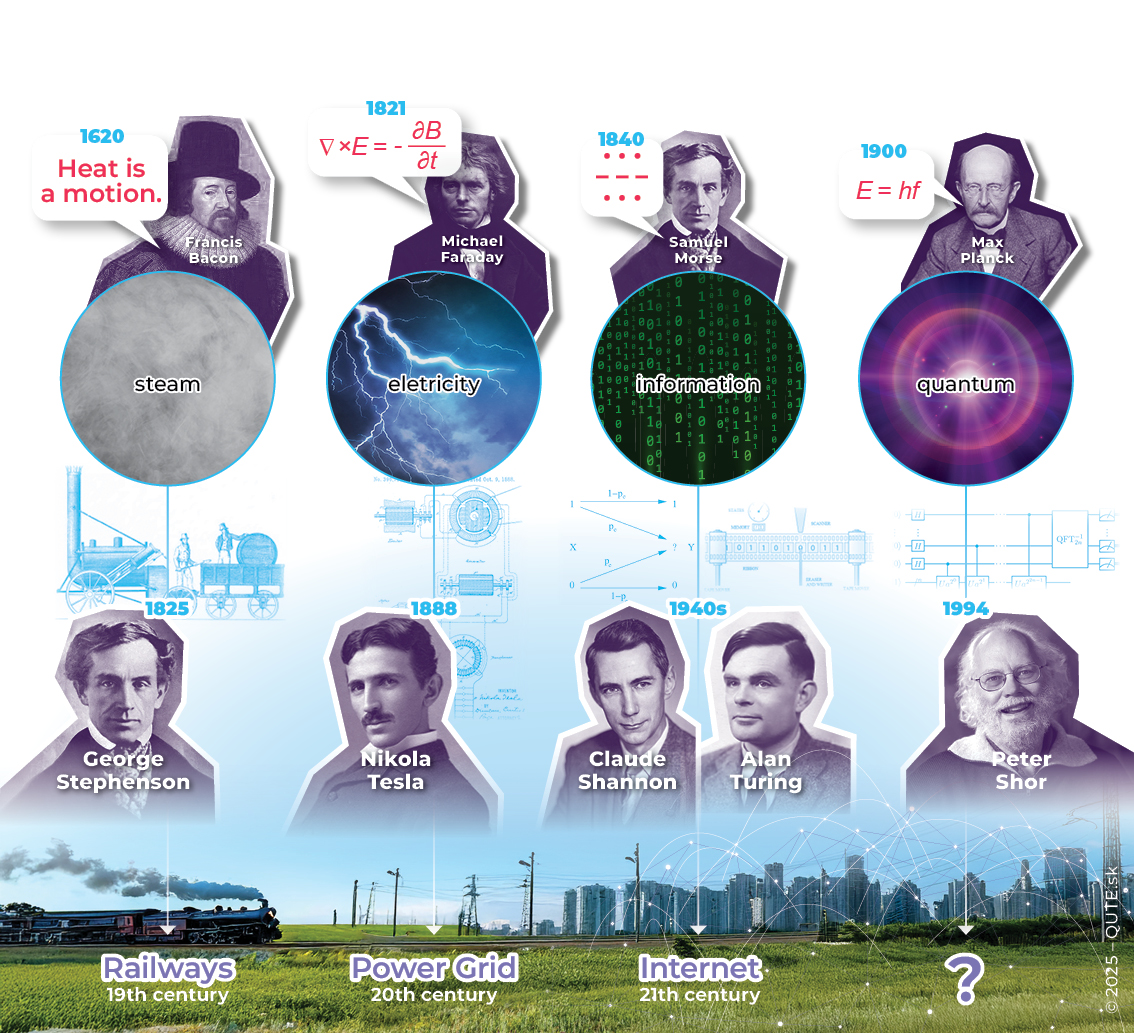
In 1620, Francis Bacon articulated the correct idea that heat is motion – not of bodies as a whole, but of their microscopic constituents. In 1825, George Stephenson constructed the steam locomotive, and the history of railway transport began. By the end of the 19th century, at the peak of the Industrial Revolution, the world was covered by railway networks, steam engines, and smog.
Legend has it that Michael Faraday, who built the first electric motor in 1821, answered a British Chancellor of the Exchequer who asked about the usefulness of electricity by saying that one day it would be taxed. In 1888, Nikola Tesla patented the transmission of electricity using alternating current, and in the second half of the 20th century the world became covered by electrical grids and electrical devices.
Samuel Morse patented the telegraph as early as 1840. The notion of pieces of information (bits) began to be discussed more generally only after the work of Alan Turing (Theory of Computation) and Claude Shannon (A Mathematical Theory of Communication), roughly a hundred years later. At the beginning of the 21st century, information and communication technologies flooded the world, the internet spread globally, and today it seems that the internet has itself become a world.
For better or worse, steam made the transport of matter more efficient, electricity enabled the transport of energy, and the internet enabled the transport of information. Making predictions – especially about the future – is difficult, but history teaches us that it takes several generations for an idea, theory, or invention to generate a qualitative, society-wide transformation. A hundred years ago, physics began to uncover the quantum world. It is natural to expect that it will bring about another revolutionary leap.
The Second Quantum Revolution
In fact, many of today’s devices and materials exist only because we “understand” the quantum world. Nuclear power plants, transistors, and lasers are prime examples. Energy sources and information transfer already exploit the consequences of quantum physics, and therefore we say that quantum physics has already brought about a technological revolution. Computers, the internet, and medical diagnostics would not be what they are today without research into quantum phenomena.
Modern technologies are based on quantum effects, but they do not exploit them directly. Which nucleus decays in a nuclear power plant is random; what matters is that some nucleus does decay and releases energy. The operating mechanism of a transistor is related to quantum tunneling of electrons and quantum uncertainty, but in electronic circuits only the correct generation of current and voltage is important. A laser beam consists of photons, but in applications it is primarily the energy carried by the beam as a whole that matters.
From the second quantum revolution we expect “true” quantum technologies – devices that exploit the quantum properties of individual quantum systems. Research in this area began in the last decade of the 20th century. Today we are in a phase of intense quantum innovation and emerging investments.
The idea that we will exploit the quantum properties of individual photons and electrons sounds exciting. But what for, exactly? Let us begin by listing quantum properties: randomness, uncertainty, indistinguishability, and nonlocality. A natural reaction to these properties is that optimism fades and doubts arise. Technology is associated with reliability, whereas the quantum world seems to offer primarily uncertainty. What can be done with that?
Quantum Pieces of Information
There are many ways to “possess” one bit of information. The specific method depends on the situation and the application. All of them, however, have one thing in common: even though a bit of information is an abstract object, its physical realization is always governed by the laws of physics. Physics determines how fast we can process information, how long encoded information persists, how quickly it can be communicated, and how much energy all of this requires.
Encoding a zero and a one into a physical system requires identifying two distinct states of that system. States are possible “existences” of the same system that differ in the values of physical parameters. Quantum systems can also exist in different states and are therefore capable of hosting a bit of information. And not only that. On the one hand, they must contend with uncertainty and randomness; on the other hand, this grants them a new quality. Thanks to it, it makes sense to introduce the concept of the quantum bit (qubit) and to distinguish it from a classical bit.
Bit vs. Qubit
Both a bit and a qubit encode at most one bit of information. Anything we can do with bits, we can also do with qubits – but not vice versa. There exist quantum operations that cannot be interpreted as transformations of zeros and ones. We say that they create superpositions of logical values – states in which qubits do not have well-defined logical values. If we attempt to determine them, we find that the outcomes are random.
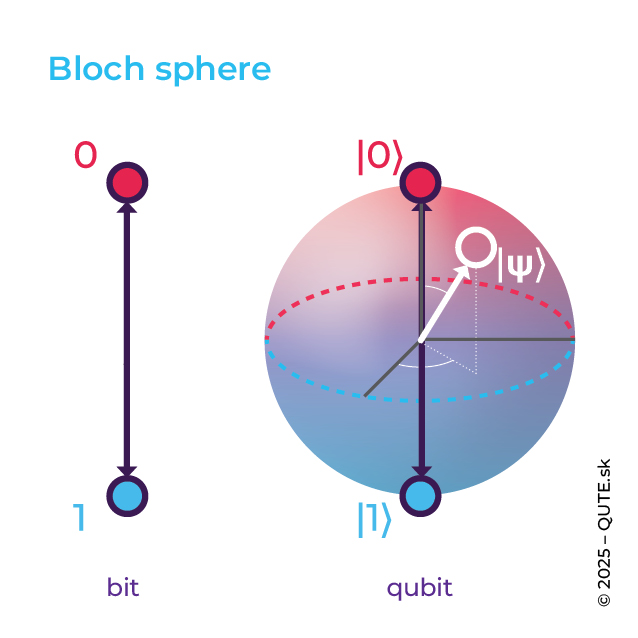
Superpositions are not vague numerical values or properties somewhere between zero and one. They are well-defined quantum values (states) of a qubit, just as well defined as those that encode zero and one. Quantum states of a qubit can be visualized as points on the surface of a sphere – the endpoints of vectors pointing from the center of the sphere. The components of the vector, however, are quantum-mechanically uncertain with respect to each other. A qubit has a well-defined component only along one direction, and it can take only two definite values, corresponding to states with oppositely oriented vectors.
The difference between a qubit and a classical bit lies in how many different ways they can encode the value of a bit of information. In the case of a qubit, the number of possibilities is infinite – any pair of oppositely oriented vectors. In the case of a classical bit, there are only two options – we choose which of the two states we call zero and one. The choice of a particular encoding of zero and one depends on which component of the qubit we can measure most efficiently. Regardless of how this encoding is chosen, all other states are superpositions of the two selected states.
If we wanted to simulate qubits on today’s computers, we would need to include the aforementioned extension of possible quantum values and quantum logical operations. The number of parameters required grows exponentially with the number of qubits and rather quickly exceeds even the capabilities of supercomputers.
Quantum Technologies
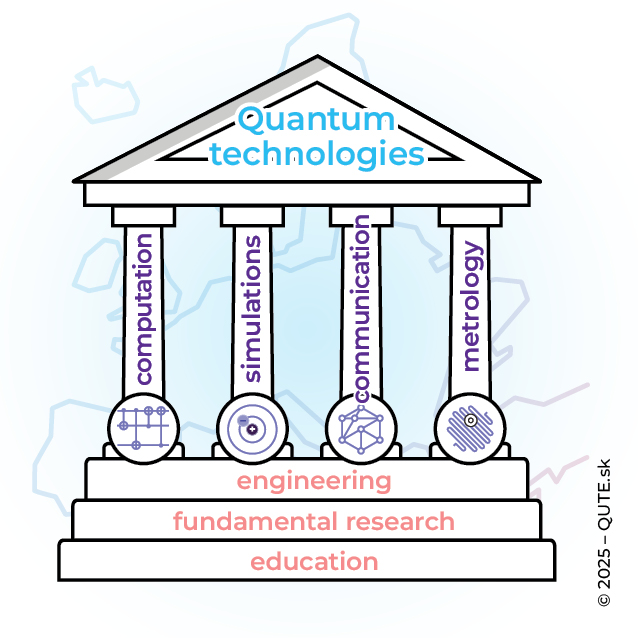
In addition to increasing computational power, quantum technologies also have applications in other areas. The sensitivity of quantum systems to environmental influences makes them particularly suitable for the development of new measurement sensors (gravimeters, magnetometers, and others). In theory, quantum sensors could operate with a quadratically smaller amount of data, which would significantly accelerate signal processing, for example in robotics as well as in space technologies.
Quantum uncertainty intuitively allows information to be hidden more effectively in qubits and enables the creation of quantum cryptographic systems whose security is based on the validity of physical principles. Today we are in the stage of building experimental quantum communication infrastructure, that is, a quantum communication layer of the internet. In addition to terrestrial segments, the launch of satellites is being prepared to support global, quantum-secured information transfer. In a few decades, quantum cryptography may become a standard, providing an unbreakable method for securing the most sensitive data.
A quantum computer is the primary goal of quantum technology development. We cannot say when this moment will arrive, or whether it will arrive at all. It is, however, expected that by the middle of this century we will use quantum simulators – quantum systems dedicated to specific types of tasks – for modeling purposes. These devices may help us model new materials and pharmaceuticals and may even enable a qualitative leap toward general artificial intelligence.
Author of the article: Mário Ziman, Institute of Physics, Slovak Academy of Sciences, Bratislava
Illustrations: Diana Cencer Garafová, QUTE.sk – Slovak National Center for Quantum Technologies
Image source: wikipedia public domain, www.nobelprize.org.

Author