

QUANTUM WORLD
The Probable Face of Truth
Almost everyone has found themselves in a situation where they really needed to roll a six on a die. Some people blow on the die, some ask higher powers for help, some trust in the skill of their own hand, and some throw the die off the table and triumphantly shout “Six!” hoping to get away with it. We all know that rolling a die is a matter of chance…
Thanks to physics, we know that if we take 80 steps per minute, we’ll get to a shop that’s 640 steps away in 8 minutes. It’s something we can easily calculate. In the same way, we can calculate where a launched rocket will land. When we roll a die, we can also calculate the possible results. The same works the other way around: if we want to arrive at the shop in seven minutes, we can figure out how fast we need to walk. We can either increase the number of steps per minute, lengthen our stride, or do something in between. And if we want to roll a six, there are even more possible ways to achieve it. So where’s the problem, and why do we call rolling a die a matter of chance?
Throws Without Randomness
To calculate anything, we need to know the input values. When determining how long it will take us to reach a shop, those values are the length of the path, the length of our step, and the frequency of our steps. If we’re a bit inaccurate in estimating them, the time we arrive at the shop won’t differ much. However, the situation is different when rolling a die. Even a tiny change in the initial conditions can cause a significant change in the final outcome. That’s why rolling a die appears to be a random process. The further into the future our predictions reach, the more they differ, even if the difference in the initial conditions is negligible. This property also applies, for instance, to weather forecasting or three-body systems (such as the Sun, the Earth, and the Moon).
The randomness we talk about in classical physics expresses our practical inability to determine and control all the necessary parameters of these systems. Nevertheless, these systems, and their behavior, are not truly random. When a six appears in a particular throw, it happens because we threw the die that way. We simply can’t throw a six on purpose, as we don’t control our hand with perfect precision, the die isn’t ideal, and the surface it lands on is quite uneven under a microscope. The sensitivity of the outcome to small inaccuracies in the initial setup affects its predictability. Still, by adjusting the way we throw, we can increase the chance of rolling a six. Probabilities, therefore, can be predictable.
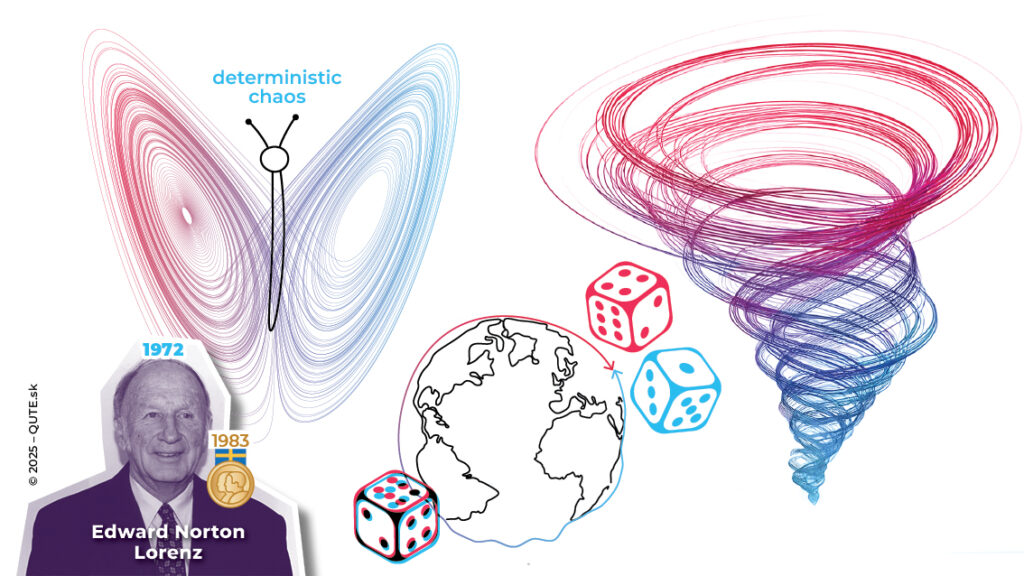
The Butterfly Effect (Edward N. Lorenz, 1972) illustrates the sensitivity of a system’s evolution to its initial conditions using the example of weather. A difference as small as the flap of a butterfly’s wing in the Amazon rainforest could cause a tornado instead of a drought anywhere on Earth. The depicted butterfly wings represent a so-called strange attractor— a concept that arises in the study of deterministic chaos.
Quantum of Randomness
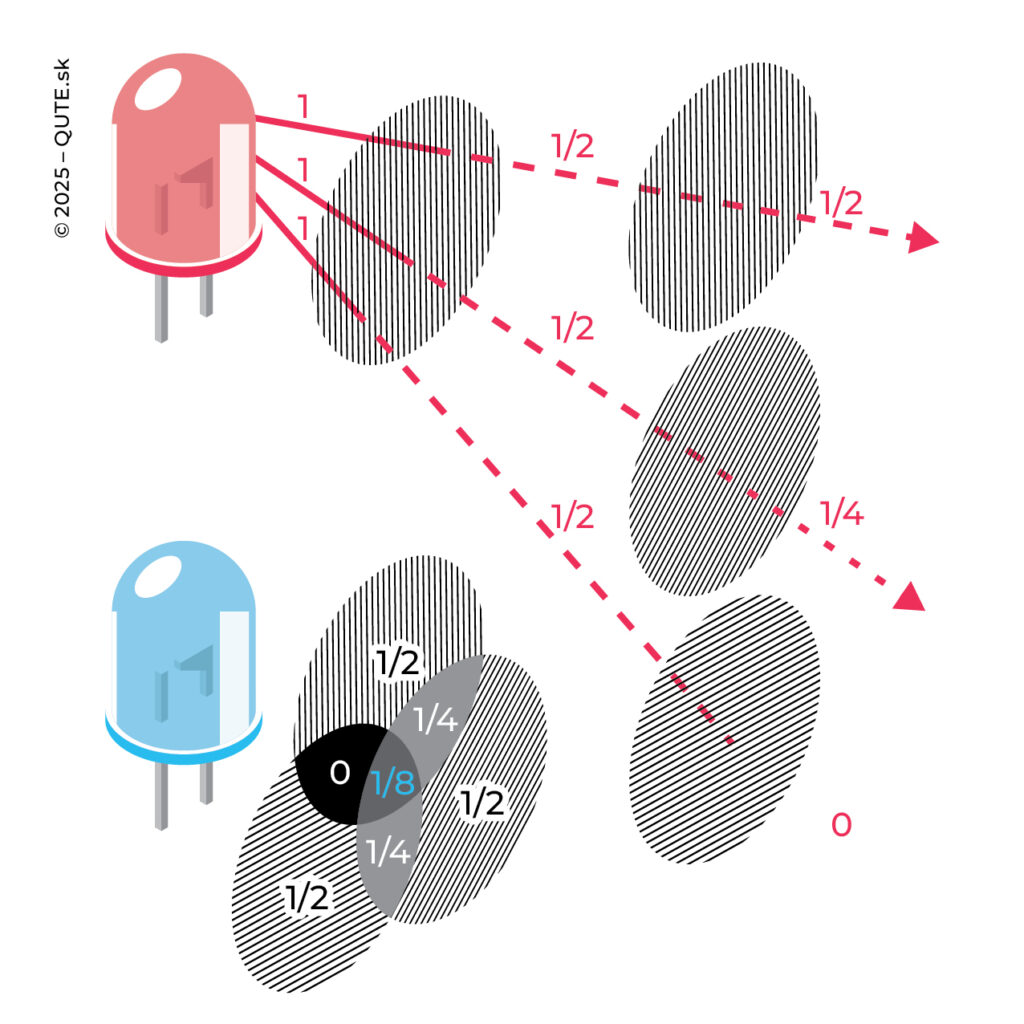
Polarization: The image shows photons passing through polarizing filters oriented at different angles. According to Born rule, the probability of a photon passing through a filter is given by |cos[α]|2, where is the angle between the polarizers. The “magic moment” occurs in the middle of a three-filter setup: when a rotated filter is inserted between two perpendicular filters, which individually block all photons, it allows some photons to pass through.
Light has a property that our eyes are completely insensitive to: polarization. We know about it, for example, thanks to Icelandic calcite – the legendary Viking sunstone. When properly cut, it acts as a polarizing filter – a device that only allows light of a certain polarization to pass through. Ordinary light sources are unpolarized, so a polarizing filter reduces the light’s intensity (the number of photons) by roughly half. Adding another identical polarizer doesn´t further reduce the intensity. Why? Because after passing through the first polarizer, the light is already “properly” polarized, so the second polarizer has nothing left to filter out. The hidden mystery in polarization appears when we rotate the second polarizer around the axis along which the light propagates. The intensity of the light passing through the second polarizer depends on the rotation angle α, and at α = 90°, the light is completely blocked. How much light the polarizer blocks depends on its orientation.
Things become more interesting when we consider that light is made of photons. Polarization describes how the traveling light induces oscillations in the electric and magnetic fields around it. At the photon level, polarization is a property that a photon can change. For example, when passing through a polarizer. But how do we explain the reduction in intensity? The idea that only part of a photon passes through is incorrect because it would imply a change in the photon’s energy, and therefore its frequency. Nothing like this is observed. Instead, a polarizer simply allows some photons to pass while blocking others. If the angle between the first and second polarizer is α = 45° , half of the photons that passed the first polarizer will pass the second, and half will not. What decides which photon passes and which doesn’t? We don’t know.
The Mysteries of Randomness
Even quantum physics doesn´t provide a way to calculate whether a specific photon will pass through a polarizer or not. This process is considered as an act of pure chance – a randomness that doesn´t result from an inability to set up or measure conditions more precisely, as in rolling a die. In this case, we must accept that a photon passing through a polarizer is fundamentally random. Thanks to quantum physics, however, we can correctly predict the probabilities of whether a given photon will pass or not. It is not the outcome itself but the probability of the outcome that we can calculate precisely.
It´s not easy to accept, but randomness is one of the most fundamental features of quantum physics. In the famous statement “God does not play dice,” Albert Einstein expressed his skepticism toward quantum randomness. This feeling is not unique. As another great mind put it: “We can argue about it, we can disagree, but that is probably all we can do.” Randomness has its firm place in the quantum world. The rule for calculating the probabilities of any quantum parameter is known as the Born rule, named after the German physicist Max Born, who, along with his students Pascual Jordan and Werner Heisenberg, formulated the first comprehensive theory of the microscopic world (matrix quantum mechanics) in 1925. In honor of these contributions, the UN declared this year the International Year of Quantum Science and Technology.
Probability applies to every parameter of a quantum system – not only the passage through a polarizer, but also the position of an electron in an atom or the decay time of a nucleus in a nuclear reactor. However, this doesn´t mean that quantum systems behave unpredictably. In the background, the quantum world follows clear deterministic laws. Schrödinger’s equation, which describes the time evolution of quantum systems, contains no randomness. Randomness arises “only” in the results of specific measurements, while quantum physics fully controls and can successfully predict the probabilities of these outcomes, which can also be experimentally verified.
When observing quantum systems, their properties change in discrete jumps. Every photon that passes through the same polarizer has the same polarization value. This change is not a result of Schrödinger’s equation and is not deterministic. Since the birth of quantum physics, the randomness observed in measurement has been the subject of many discussions. Its secret has not yet been uncovered, and it´s not clear that any secret is hidden at all.
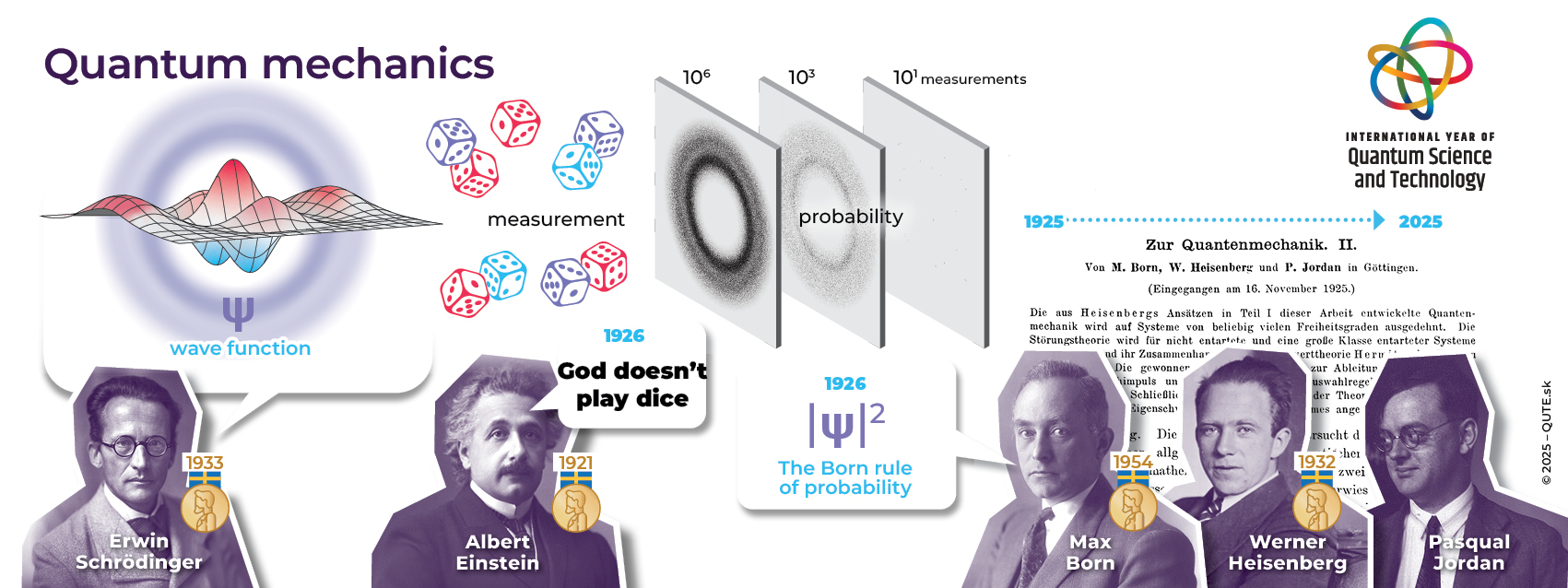
The Born rule/Born’s Rule (Max Born, 1926) tells us how the observed quantum probabilities (on the right) are obtained from the deterministic quantum-mechanical description of a quantum system (on the left). www.quantum2025.orgwww.quantum2025.org
The Advantages of Randomness
At first glance, it may not seem so, but randomness is just as useful as certainty. Artificial intelligence, simulation and optimization algorithms rely on sources of random numbers to reach results more efficiently. For the security of encryption keys, uniform randomness is essential – meaning that the values 0 and 1 are generated with equal probability. Processors themselves cannot generate true randomness, so we use special devices called random number generators (RNGs).
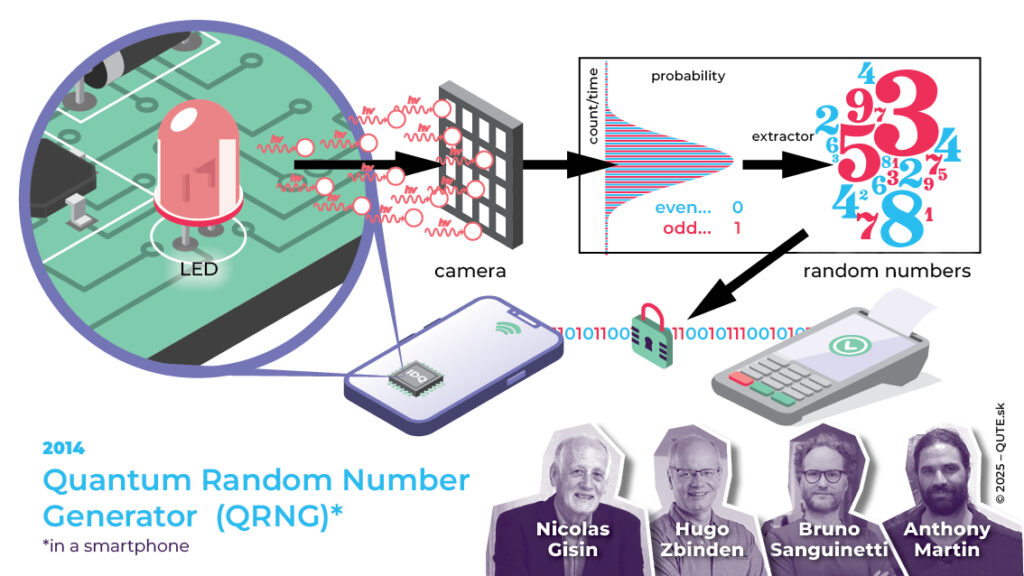
Quantum Random Number Generator. The image illustrates, in a simplified way, the physical principle of the Quantis QRNG chip (measuring 2,5 x 2,5 x 0,84 mm) embedded in a smartphone. The camera records the number of detected photons, whose probabilities follow a Poisson distribution. An even count is assigned the value 0, and an odd count the value 1. The resulting values have practically equal probabilities. To detect any difference, the device would have to be used 10118 times. (adapted from QUTE.sk)
RNGs are a subtle but extremely important and widely used technology. And quantum systems, with randomness in their “genes”, are ideal for building such devices, whether they rely on photons passing through a polarizer or on radioactivity. Certified quantum random number generators (QRNGs) can already be purchased, connected, and used. Some smartphones even come with a built-in QRNG that uses quantum randomness in the number of emitted photons by a photodiode to generate random bits (several gigabits per second). Randomness that brings certainty to our data and communication.
Author of the article: Mário Ziman, Institute of Physics, Slovak Academy of Sciences, Bratislava
Illustrations: Diana Cencer Garafová, QUTE.sk – Slovak National Center for Quantum Technologies
Translation: Gabriela Kotúčová
Image source: wikipedia public domain