
Quantum World
Quantum communication networks
The era of the global communication network began quietly on October 29, 1969, when programmers Bill Duvall and Charley Kline successfully sent the command “login” from a computer at Stanford to a computer at Caltech on their second attempt.
Bits of information transmitted over the internet are encoded into electromagnetic signals. For each transmitted bit, we use on the order of tens of millions of photons. Along the way, these signals are replaced several times. Due to noise in optical fibers, the original signal gradually weakens. An amplifier or repeater is a device that restores the signal. From a weakened signal, it creates an improved copy that continues on its way to the receiver. The result is a practically functioning system of digital communication. Here, we will look at where and how quantum technologies can help in this system.
Forever dangerous?
Hand in hand with the need for communication came the need to conceal its content. History is full of fascinating stories about creating and breaking secret communication systems. In digital communication, zeros and ones are transmitted and are accessible to anyone who has access to the connection. Encryption consists of hiding the way a specific message is rewritten into zeros and ones. To decrypt an encrypted message, the receiver needs an encryption key. Its secure creation without the possibility of guessing it is the holy grail of cryptography.
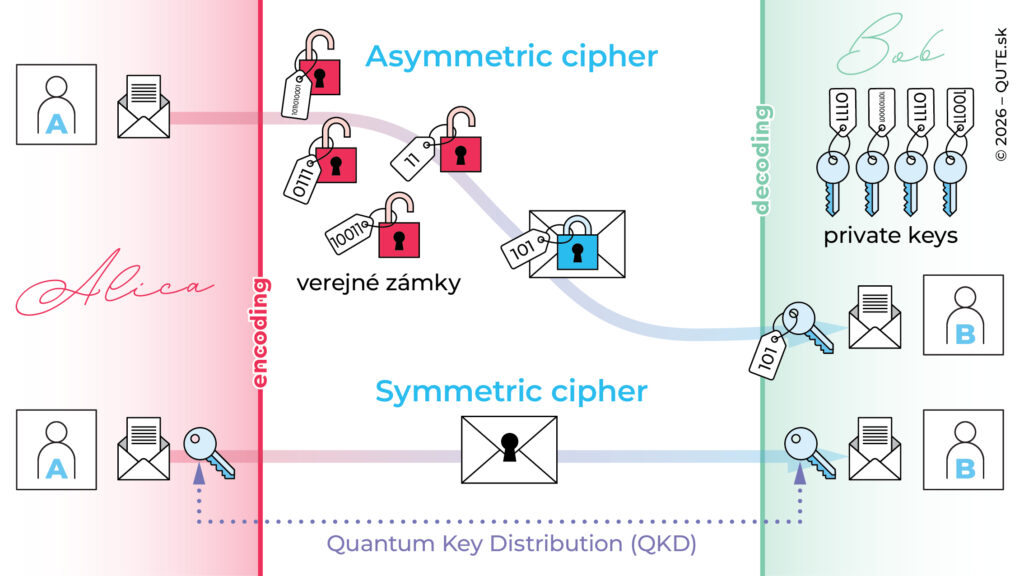
Symmetric and asymmetric cipher – illustration of the principle
Modern security is based on the concept of asymmetric encryption, in which so-called public encryption keys are used to lock messages but do not allow them to be unlocked. The public key is created by the recipient together with a so-called private key, which is not disclosed and is used to unlock the encryption. The existence of a theoretically secure asymmetric cipher has not been proven, and asymmetric cryptosystems are based on the belief that we cannot efficiently compute the private key from the public key and the received encrypted message.
The currently used RSA cipher (named after R. Rivest, A. Shamir, and L. Adleman, who created the algorithm in 1977, ed.) is based on the fact that all known algorithms for decomposing a number into prime factors (factorization) are computationally exponential in complexity. Even the best supercomputers would need longer than the age of the universe to break it. Computational complexity thus serves as a guarantee of security. Everything works well until a fully functional quantum computer enters the market, or until someone invents an exponentially faster factorization algorithm. In both cases, a certain form of collapse of the social system would occur, not only in the virtual world of the internet – information would leak, identities would be lost, finances would disappear… What can be done about it?
Post-quantum security
A natural solution is to change encryption systems. However, the threat of discovering a new algorithm will always persist until someone invents a provably secure asymmetric cipher. At the moment, we are in a situation where we have an efficient quantum algorithm (Shor’s algorithm) for breaking RSA encryption, but we do not yet have a device (a quantum computer) capable of implementing it. Over the past thirty years, quantum technologies have made significant progress, and there is a reasonable chance that a quantum computer with sufficient computational power to break RSA encryption may appear in the coming decades.
This threat has motivated the development of so-called post-quantum cryptography. Similar to RSA, their theoretical security is not proven, but they are resistant to known factorization algorithms, including Shor’s. However, history may repeat itself, and efficient algorithms – classical or quantum – may still emerge. Quantum technologies, however, also offer a better option.
Quantum layer of security
There exists a theoretically secure way of encryption – a symmetric cipher, in which the same encryption key is used to lock and unlock the message. However, this key can be used only once. Reusing it dramatically increases the attacker’s chances of discovering it. But how can such an encryption key be securely created between the sender and the receiver?
Technologies based on qubits offer us a quantum-secure solution. Quantum protocols for quantum key distribution (QKD) allow, by sending quantum bits (typically in the form of photons), the creation of completely random and identical strings of zeros and ones between sender and receiver, which form a unique encryption key. Once we have the keys, nothing prevents us from using a symmetric cryptosystem, also known as a one-time pad, and communicating in a truly secure way. What do we need for this?
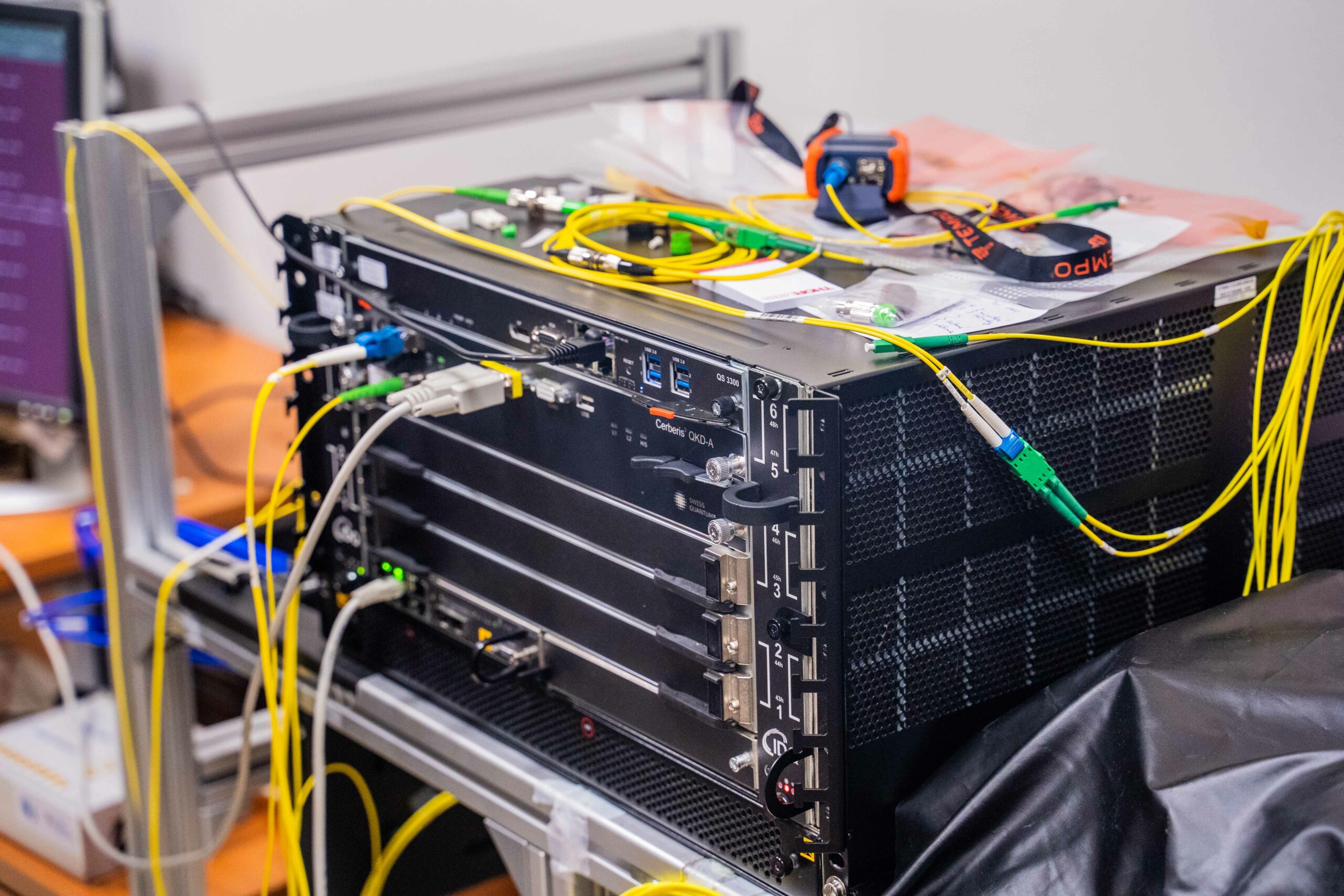
Implementing quantum protocols in practice requires a certain hardware upgrade of existing communication infrastructure, but there is no need to build entirely new connections. Existing optical fibers are sufficient. However, at the nodes themselves, we need to add a quantum hardware layer capable of generating and processing signals at the level of individual photons.
A quantum (in)secure world
Since 1984, when Charles Bennett and Gilles Brassard designed the first QKD protocol known as BB84, the development of single-photon sources and single-photon detectors has made enormous progress. QKD devices can now be purchased, installed, and used without understanding the principles behind their operation. The use of QKD is also being widely tested in practice around the world.
Europe is no exception in this regard. Despite being a long-term leader in research in this area, it is lagging behind in applications. The very first company focused on QKD devices was founded more than 20 years ago in Switzerland and is now owned by Americans. China has been operating a quantum-secured network spanning thousands of kilometers for years, and it continues to grow every day. Satellites designed for quantum communication – originally proposed by a team led by Nobel Prize winner A. Zeilinger from Austria – were ultimately launched by China. It is also China that is testing the use of QKD for military communication purposes on the front line.
Attenuation and the emergence of technologies
Attenuation in optical fibers also affects the quantum signal. Creating a key over distances greater than 150 km is at the edge of practical usability. The technological holy grail is the implementation of quantum repeaters – devices that would allow us to extend this distance. There is a theoretical model based on quantum teleportation, and laboratories around the world are trying to build such a quantum repeater.
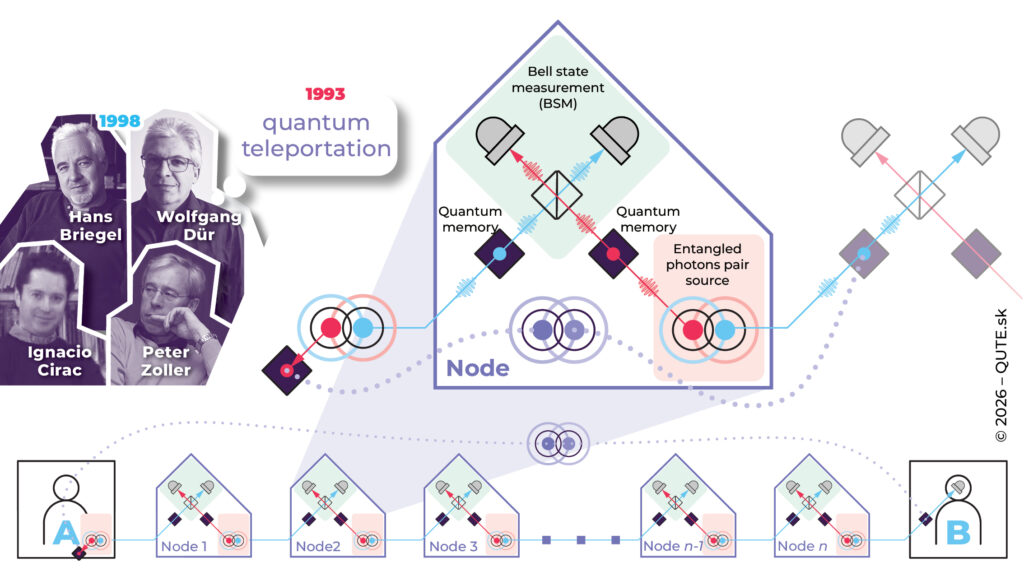
Quantum repeater. A protocol enabling the transmission of a quantum signal over arbitrary distances. Its operating principle is based on quantum teleportation.
The second option is to change the medium through which the quantum signal is transmitted. Unfortunately, we do not have better optical fibers. However, we know that at altitudes above 50 km, the signal propagates with almost no attenuation. And getting it there through the lower layers of the atmosphere with acceptable loss is not impossible. We only need ground stations and satellites that will relay the signal between each other.
Currently, communication over a quantum-secured network is only as secure as the trustworthiness of the nodes where devices for generating encryption keys using QKD are located. If we want to connect Bratislava and Košice, we need several intermediate stations that create encryption keys between each other and then use them to generate a shared encryption key between Bratislava and Košice. This is known as a trusted-node encrypted link.
A quantum-secured Europe
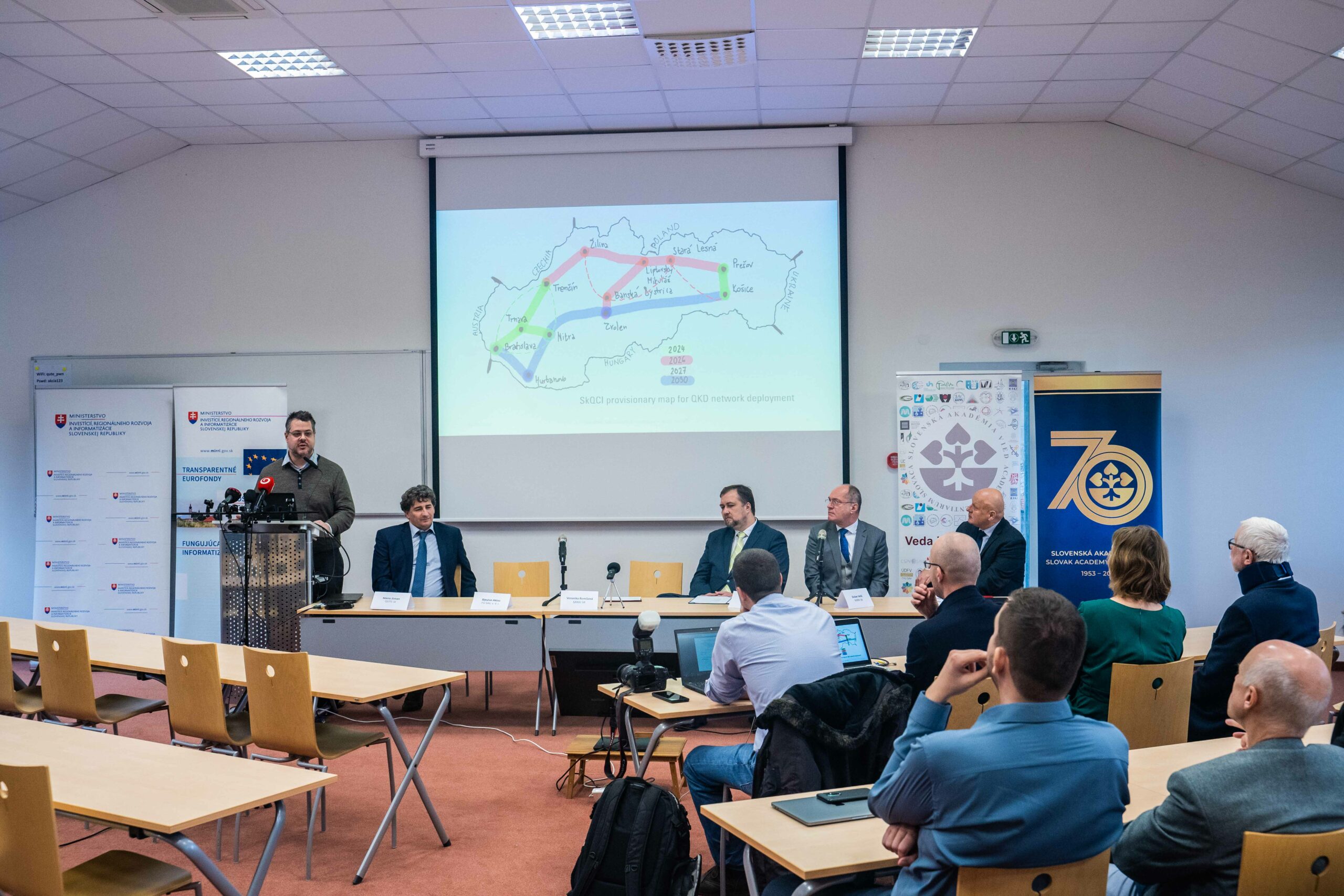
Within the EuroQCI project, Europe has set itself the goal of creating a Europe-wide experimental quantum communication network by 2030. In the first phase, which ends this year, backbone links are being built within individual countries. In the already ongoing second phase, individual countries are being interconnected and ground stations for QKD links to satellites are being established.
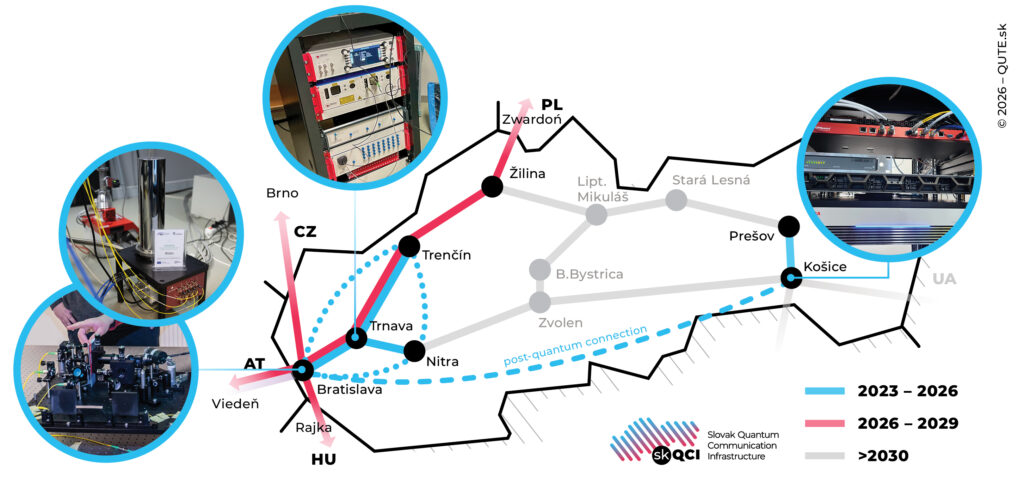
In western Slovakia, an experimental network can be seen with a source of entangled photons for the BBM92 protocol and a detection system at the Faculty of Physics of the Slovak Academy of Sciences (FÚ SAV) in Bratislava, as well as the same system in a more compact version at the Faculty of Materials Science and Technology of the Slovak University of Technology (MTF STU) in Trnava. In eastern Slovakia, a connection between the Faculty of Science of Pavol Jozef Šafárik University (PF UPJŠ) in Košice and the University of Prešov (PU) has already been launched, based on a solution using the BB84 cryptographic protocol. Dotted lines represent connections without optical fibers, using quantum teleportation.
In Slovakia, EuroQCI activities have enabled us to build our own expertise in quantum communication technologies as well as several quantum links. At the end of last year, a BB84 connection between Košice and Prešov was brought into operation. This year, we will launch a quantum network in western Slovakia based on the more advanced BBM92 technology with our own components. A metropolitan quantum network connecting state institutions within Bratislava is also planned.
Author of the article: Mário Ziman, Institute of Physics, Slovak Academy of Sciences, Bratislava
Illustrations: Diana Cencer Garafová, QUTE.sk – Slovak National Center for Quantum Technologies
Image source: wikipedia public domain, Institute of Physic, Slovak Academy of Science