


Quantum World
Incredibly Entangled World
New York Times, May 4, 1935 – Einstein attacks quantum physics. The defense was not entirely convincing and led to a “freeze” of the conflict for several decades…
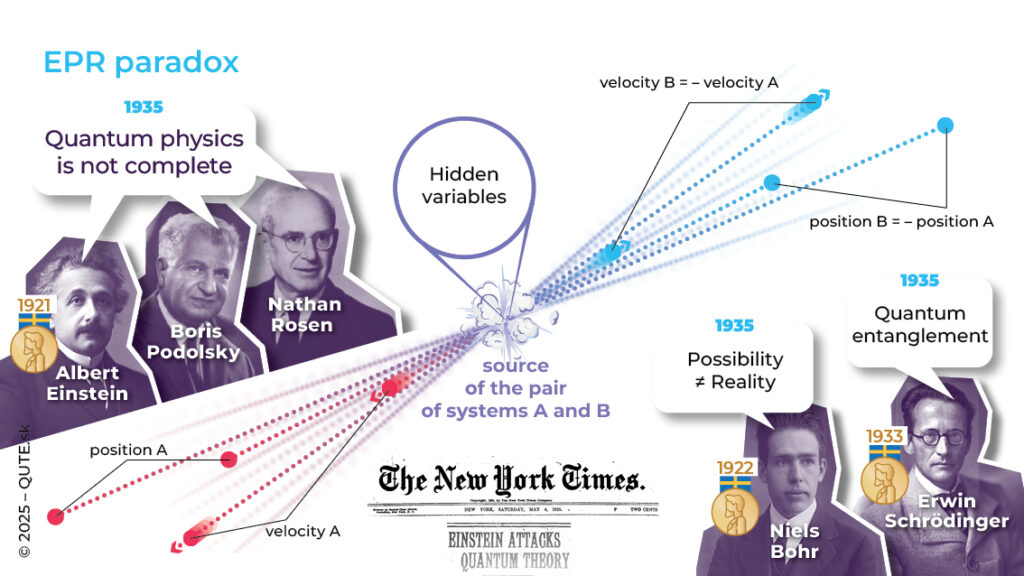
The headline was somewhat misleading, and Albert Einstein reportedly was not pleased with it. The actual scientific paper appeared in Physical Review on May 15, 1935, titled Can Quantum-Mechanical Description of Physical Reality Be Considered Complete? In it, A. Einstein, B. Podolsky, and N. Rosen describe a physical situation (now known as the EPR paradox) in which quantum objects influence each other at a distance without any direct interaction. This contradicts our everyday experience. EPR referred to this as “spooky action at a distance”, highlighting the non-locality of quantum reality.
Assumption of Reality
The public questioning of quantum physics required a firm response. Five months later, Niels Bohr, then the leading advocate of the quantum physics community, replied with a scientific paper with the same title. He reduced the problem to the seemingly metaphysical question of whether the assumption that individual systems possess definite properties independently of observation is valid – do these properties exist whether or not we measure them?
Erwin Schrödinger also responded to the EPR paper in his November 1935 trilogy The Present Situation in Quantum Mechanics. He did not dispute the arguments of EPR but identified quantum entanglement of properties (measurement outcomes) between two different systems as the essence of quantumness, including the EPR paradox. Schrödinger demonstrated that quantum physics consistently explains all observed phenomena and that its apparent conflict with the notion of local reality is a general feature of quantum reality.
Indeterminate Realities
We are used to thinking that the properties of systems are real and exist independently of experimental measurement. If we take a ball from a box and see that it is white, it is natural to assume that it was white even before we looked. This is not the case for quantum “ball”.
Quantum uncertainty teaches us that knowing the probability of a system having a certain property does not mean that the system actually possesses that property. To give probabilities any real meaning, we must obtain information about the property – i.e., perform a measurement. At the same time, however, the measurement alters the probabilities of other properties of the system, including the measured one.
For quantum systems, we cannot claim that position and momentum are real properties of individual systems. We can speak of the probabilities of position and momentum separately, but quantum uncertainty prevents us from talking consistently about the joint probability of position and momentum values. Position and momentum are incompatible properties of quantum systems.
Non-Local Realities
Einstein, Podolsky, and Rosen considered two systems moving away from a common point, randomly but with identical velocities. Their positions are also random but equally distant from the starting point. Both statements are predictions of what we would observe if we measured their velocities or positions. However, we must choose which measurements to perform to turn predictions into actual observations of velocity or position.
Predictions tell us that velocities and positions of the systems are perfectly correlated. Measuring the velocity of one system allows us to know what the measurement would yield for the other. We might think that both velocity values are real. A similar conclusion arises if we measure the position of the first system. It seems as though the choice of measurement on the first system influences the “real” properties of the second system.
This holds even if the systems are so far apart that any mutual influence is impossible. If we exclude influence, then logically the second system must have “real” properties (position and velocity) already determined before measurement. This, however, conflicts with Heisenberg’s uncertainty principle. The paradox disappears if we either accept that real properties of objects can somehow be influenced at a distance or abandon the idea of the existence of predetermined properties.
Hidden Realities
The EPR trio did not claim that the predictions of quantum physics were wrong. They accepted quantum physics as an effective theory of microscopic reality. They proposed a hypothetical theory of hidden local variables, describing physical reality but potentially inaccessible to us. According to this view, quantum physics is only a statistical approximation of this “more fundamental” physics, just as thermodynamics is a statistical approximation of statistical mechanics.
For a long time, the EPR paradox received little attention. Sporadic discussions occurred in relatively small physics communities. The breakthrough came in 1964 with John Stewart Bell, who considered the observable consequences of the existence of hidden local variables. He formulated experimentally testable predictions, now known as Bell’s inequalities.
Bell also calculated that quantum systems in special situations, similar to those considered by EPR, violate these inequalities. Quantum physics as we know it cannot be replaced by a hidden variable theory. We must either revise our intuitive ideas of physical reality or modify physics itself.
Experimental Realities
In 1972, John F. Clauser, with his graduate student Stuart J. Freedman, conducted the first test of Bell’s inequalities for photon pairs with entangled polarizations at Berkeley. They found that the inequalities were violated, in agreement with quantum physics. Ten years later, Alain Aspect and his team at Orsay performed an improved test, in which detector settings were chosen after the photons left the source, ruling out the hypothetical possibility that photon creation depends on the measured property. Despite observed violations, some hypothetical interpretations remained inconclusive.
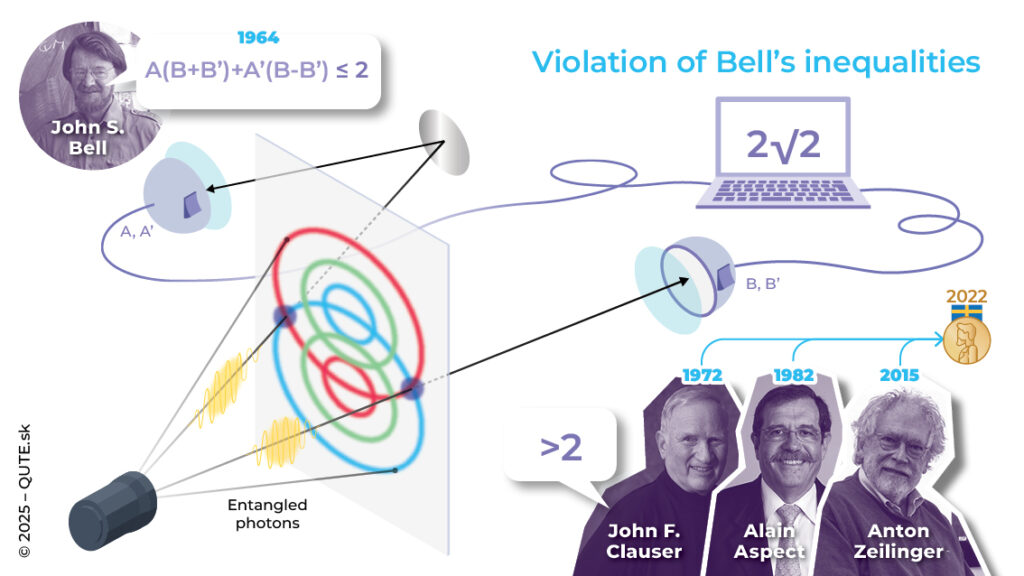
Only in 2015 were all loopholes closed. First, a team in Delft demonstrated violations between electron spins, later the same year, experiments in Boulder (NIST) and Vienna under Anton Zeilinger independently ruled out hidden local variables for photons.
Entangled Realities
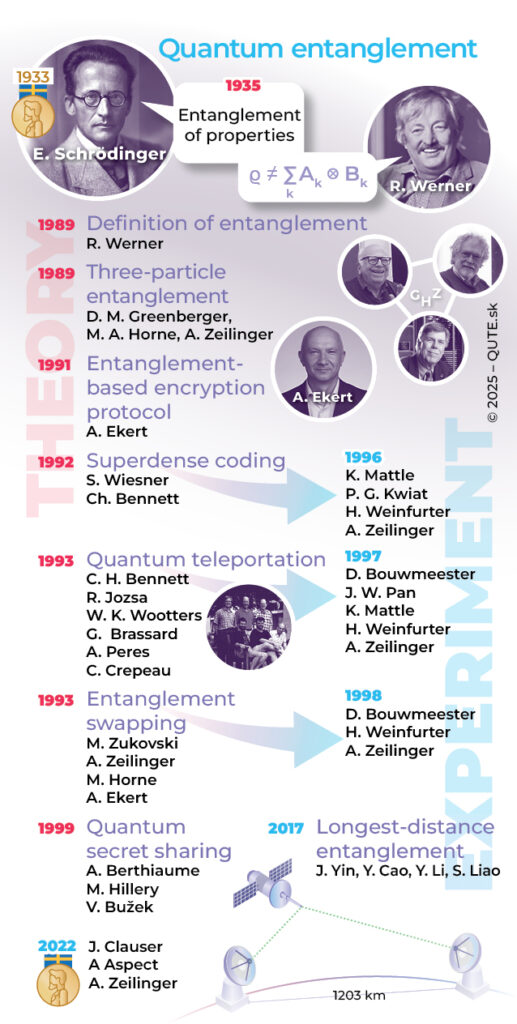
Violation of Bell’s inequalities is a manifestation of quantum entanglement, mathematically formalized in 1989 by Reinhard Werner. In the 1990s, entanglement theory advanced rapidly. Charles Bennett and colleagues discovered quantum teleportation and invented quantum superdense coding – quantum generalizations of the Vernam cipher. Entanglement was recognized as essential for quantum algorithms and for quantum decoherence, the process that “destroys” quantum properties.
Anton Zeilinger and his team performed several key experiments using entangled photons. He was the first to demonstrate three-particle entanglement, perform quantum teleportation, and implement entanglement swapping, which allows creating entanglement between systems that never interacted directly. This enables long-distance entanglement, useful for quantum key distribution or qubit teleportation.
Entanglement is abundant in nature – it arises whenever systems interact – but it has limits: it is monogamous. Entanglement with a new system reduces the entanglement with the original system. Yet, the magic of non-local reality remains.
Author of the article: Mário Ziman, Institute of Physics, Slovak Academy of Sciences, Bratislava
Illustrations: Diana Cencer Garafová, QUTE.sk – Slovak National Center for Quantum Technologies
Image source: wikipedia public domain, www.nobelprize.org