


QUANTUM WORLD
Definitely Indefinite World
The magician fills the left and right pockets of a mannequin with dice. The mannequin looks exactly the same from the front and from the back. The magician closes his eyes and lets a volunteer spin the mannequin around. Once it stops, the magician no longer knows which pocket was originally the left one or the right one. Does it matter? In quantum magic, it certainly does. With a die pulled from an indefinite pocket, the magician will never roll a two or a five.
The trick is an allegory of the famous double-slit experiment, which, according to Richard Feynman, illustrates the essence of quantum physics in all its complexity. The left and right pockets represent the slits, and rolling the die corresponds to the process that follows once a physical system has passed through them. The zero chance of rolling a two or a five is an effect of quantum interference.
The original purpose of the double-slit experiment was to determine whether the flow of energy (radiation) is carried by waves or by particles. If the result shows an interference pattern – alternating maxima and minima of intensity, then it must be a wave. But if the outcome resembles a “camel-back” with one or two bumps, then it must be particles. Quantum physics has successfully erased the difference between particles and waves. Quantum systems (including dice) are particles whose very existence has a wave-like nature.

An Allegory of Double-Slit Interference. The imaginary quantum die has six outcomes, just like an ordinary die. However, in the illustrated interference “trick,” some values simply cannot be rolled with such a die.
Photon by Photon
In the double-slit experiment, photons have an equal chance of passing through the right or the left slit. Based on which slit they go through, we can calculate single-slit probabilities of where they will land on the photographic plate. However, the result is not the sum of the single-slit probabilities, but an interference pattern. In the case of waves, we explain this pattern as the consequence of the mutual influence (interference) of the two waves propagating from the slits. For interference patterns of particles, we could analogously speak of mutual quantum influence between particles passing through the left and right slit.
But what if we send photons through the slits one by one? The double-slit experiment becomes even more interesting, and even more quantum, if the second photon is produced only after the first one has already hit the photographic plate behind the barrier, or collided with the barrier itself. This eliminates the possibility that the passing photons somehow influence each other. Despite this, an interference pattern still eventually appears on the photographic plate.
The common argument for adding the single-slit probabilities is based on our experience and the assumption that each individual photon must surely pass either the left slit or the right slit. But does it? When it hits the photographic plate, a photon transfers not only energy but also momentum, giving the plate an impulse in a specific direction.
A Quantum Complication
There is another quantum complication beyond randomness. Not only does the momentum in most cases fail to point toward either slit, but these momenta remain equally random even if either slit is covered. From the measured momentum, we cannot even statistically determine which slit the photon is more likely to have passed through.
Can we detect the presence of a photon directly inside a slit? Yes, but something very strange happens. Instead of an interference pattern, the photons form a hump-like distribution (resembling the hump of a camel). Once we know which slit the photon actually went through, the resulting probability becomes the sum of the single-slit probabilities, exactly as expected. The act of determining the path changes the properties of the photon and influences where it can land on the photographic plate. For completeness, note that the photon doesn´t reveal which slit it came from when it hits the plate. That information can only be obtained by observing directly at the slits.
The Reality of Uncertainty
We intuitively understand probability as an expression of uncertainty about the actual properties of the world, or about the possible alternatives of reality. Within probability theory, it´s natural to assume that even when no one is looking at the slit, the photon passes through exactly one of the slits. The double-slit experiment, however, shows that we must abandon this intuition, and that the existing language of probabilities is insufficient to describe the reality of the quantum world.
Quantum physics speaks of the probabilities of possible alternatives – the photon goes through the left slit, or the photon goes through the right slit. This doesn´t mean, however, that one of these alternatives actually occurred, or exists before the photon reaches the photographic screen. It is not uncertainty about which reality occurs, but uncertainty about whether such a reality exists at all. Generally, we can assign a probability to each specific observable property of a quantum system, describing the likelihood that this property will manifest. This doesn´t mean, however, that for an individual system a particular value of the property exists in the sense that it´s real and present even when unobserved.
Quantum Weirdness
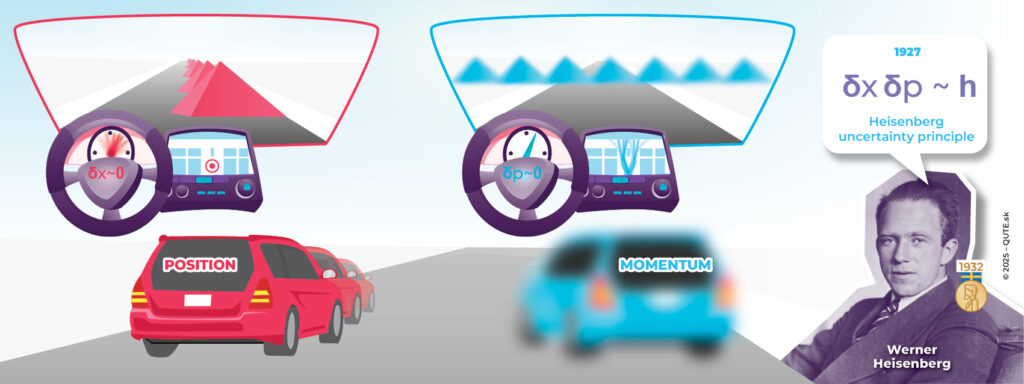
Quantum Uncertainty. In the quantum world, red car has a well-defined position, and a blue car has a well-defined velocity. In neither case is the view out the window clear. For the red car, objects appear sharp, but the distances to them are uncertain (depending on velocity), which blurs the perception of the world. For the blue car, the objects themselves are blurred, because the position of the car is uncertain. This would be the consequence of Heisenberg´s uncertainty principle if Planck’s constant was comparable to the scale of our everyday objects.
The interference pattern cannot be explained if photons, even randomly, move along definite trajectories as expected in classical physics. The mechanical picture of a photon as a moving tiny ball is unsustainable without adding certain mystical features. We can consider that a photon doesn´t pass through the slits at all, or that it passes through both slits simultaneously. We can neither confirm nor deny either of these possibilities, but both are, at the very least, peculiar. We simply have to accept the fact that a photon can appear at a specific point but cannot follow a specific path.
Uncertainty of properties
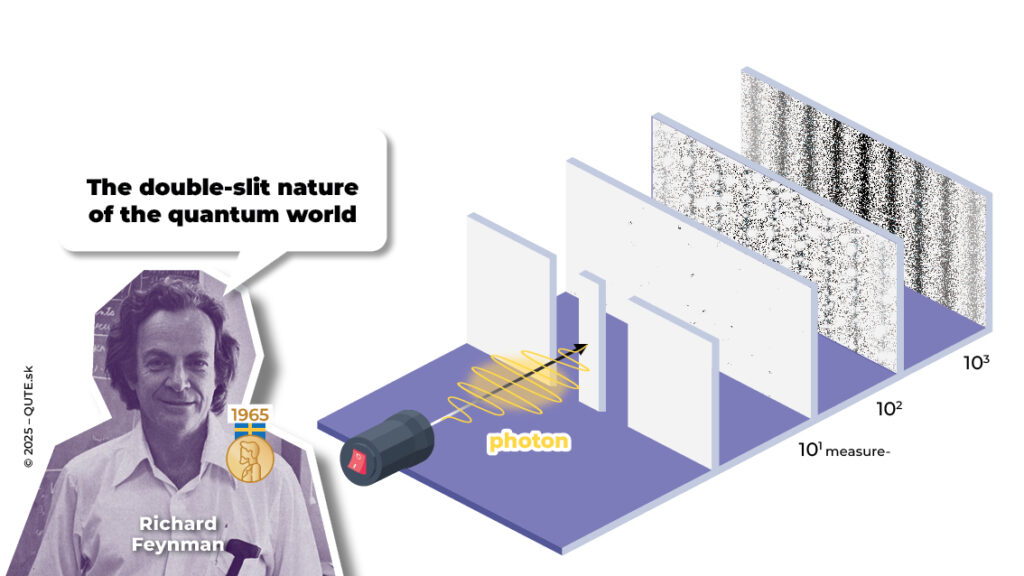
Single-Photon Double-Slit Pointillism. Each time, only one photon passes through the slits and leaves a tiny dark dot on the photographic plate. Photon by photon, they gradually dot the interference pattern. Why? Because the world is quantum.
We can talk about the trajectory of a system passing through a specific point if we know its momentum, which tells us how the system will continue moving. From the double-slit experiment, it suggests that we have a problem with quantum systems. We can calculate the probability of position and the probability of momentum. There is uncertainty in their values, but quantum uncertainty doesn´t allow us to speak of a joint probability for position and momentum. We cannot say that position and momentum are simultaneously real properties of individual quantum systems. In fact, situations in which we can assign at least one of them are rather the exception than the rule.
In 1927, Werner Heisenberg formulated the statement that the more precisely a quantum system has a well-defined position x, the less precisely its momentum pcan be known, and vice versa. He expressed the mutual uncertainty of position and momentum of a quantum system with the well-known relation δ x δp ~ h, where h = 6,626 070 15 × 10⁻³⁴ J·s⁻¹ is Planck’s constant, and δ express the precision of the measurement. If δx approaches zero, δp grows to infinity, and vice versa. As a result, when a photon is detected on a photographic plate, its momentum points in a completely random direction. From the perspective of quantum systems, the world appears truly strange. If they have a well-defined position, everything around them is in a very uncertain motion. If their velocity is constant, they have an uncertain sense of being everywhere at once.
Position and momentum are not the only properties of quantum systems that are mutually uncertain. Similar uncertainty relationships often exist between a system’s position and energy, momentum and angular momentum, and even between the individual components of the angular momentum vector. Quantum uncertainty means that not all properties of individual systems can have definite values, adding an element of mystery to quantum randomness.
Author of the article: Mário Ziman, Institute of Physics, Slovak Academy of Sciences, Bratislava
Illustrations: Diana Cencer Garafová, QUTE.sk – Slovak National Center for Quantum Technologies
Translation: Gabriela Kotúčová
Image source: wikipedia public domain